
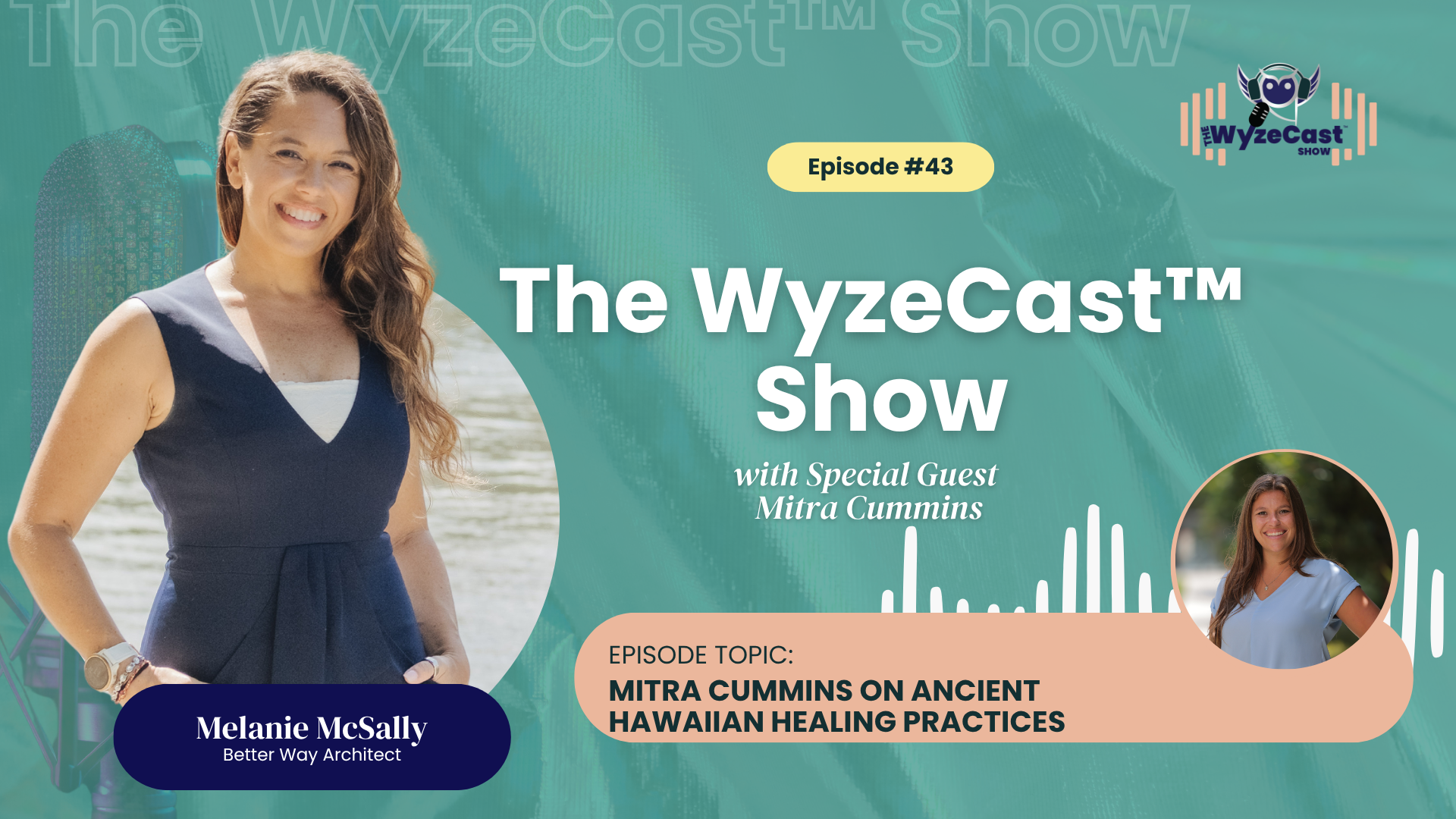
In this episode I sit down with Mitra Cummins — coach, Huna practitioner, and parent support specialist — for a conversation that took me completely by surprise. I came in knowing nothing about ancient Hawaiian healing practices. I left understanding why a lineage that has been passed down for 121 unbroken generations still matters right now, in 2026, and what it has to do with the emotional weight most of us are carrying without knowing it is there.
Premieres On YouTube & Spotify August 19th, 2026, 7 PM ET
Featuring Wyze Guest Guide Mitra Cummins
Mitra Cummins is a coach and Huna practitioner trained through Empowerment Inc. with Dr. Matt James, specializing in parent and family support, neurodivergent coaching, and emotional release work using ancient Hawaiian healing practices, NLP, and Mental and Emotional Release. She works with individuals and families to release the baggage blocking their purpose, set meaningful goals, and take aligned action toward who they are becoming. You can find her at myintrospectivesolution.com.
What We Cover in This Episode
- What Huna and Ho’omana actually are — and why the word means both “secret” and “hidden wisdom”
- The 121-generation unbroken lineage and why that depth of continuity matters
- How Ho’oponopono as practiced in the Huna lineage differs from the Joe Vitale prayer version
- Why emotions surface when you least expect them — and why the Hawaiians consider that a reason to celebrate
- The four requirements for lasting change — and why most people only address the first one
- How Mitra uses the “avatar” framework to help people clarify purpose when they do not know what they want next
- What Mental and Emotional Release is — and the study that showed a 100% success rate for depression with no relapse over three years
- Why people are not their behaviors — and how that shifts everything in how you support someone you love
The Beach Ball
Mitra grew up working with neurodiverse kids and families, then spent years going deeper into NLP and ancient Hawaiian healing practices through Dr. Matt James and Empowerment Inc. By 2020 she was well into the trainings. And she noticed an underlying anger she had been carrying for a long time.
She describes it as a beach ball you push underwater. You can hold it down. You can manage it, work around it, build a life that functions reasonably well on top of it. But it is still there, pushing back. And at some point it comes up and hits you in the face.
What she learned from Kumu Matt and the Huna lineage is that when emotions surface — even ones you thought were handled, even ones you did not know were there — it is not a problem. It is your subconscious telling you that you are ready. You have the resources now that you did not have when the thing first happened. The surfacing is an invitation.
This resonated with me in a way I want to name directly. I shared something in this episode that I do not share often — a sexual assault I experienced in my early teens, and the moment in my first in-person personal growth seminar when a parent exercise unexpectedly surfaced a wound I had no idea was there. Not blame. Not anger. Just a small inner child who noticed that her parents were not home when she needed them. I did not know that was sitting in me. Until it was not.
That is what this work reaches.
What Is Huna?
The modern label is Huna, meaning secret. But the deeper meaning of the word is hidden wisdom. And the real name of the lineage Mitra practices is Ho’omana — Ho’o meaning “to make,” mana meaning “life force energy.” To make life force energy. That is what the lineage is designed to do.
It spans 121 unbroken generations. Dr. Matt James’s father received a manuscript from the Bray family — a lineage that knew it would eventually be passed to another family, though not which one. Dr. Matt ultimately traced the full lineage backward and found 121 generations of continuous transmission. There were times when the knowledge was held quietly rather than shared openly — particularly after Western contact, when chanting and hula were suppressed and the hidden wisdom became genuinely secret for protection. But it was never broken. Never fully stopped.
When Mitra was pregnant with her daughter and heard the names of the generations read aloud, she cried. She did not know those people. But she felt like she did.
Ho’oponopono — the ancient Hawaiian forgiveness practice — is part of what is taught within this lineage. It is not the same as the Joe Vitale prayer that many people know. That prayer was modeled after Morrnah Simeona’s version. The Huna lineage version involves constructing a stage in your mind and moving through a specific forgiveness process — which is how Mitra found herself unexpectedly processing unresolved grief about her late father in the middle of a training where she thought she had nothing left to forgive.
She did.
Huna Is Not a Religion
This came up because it needed to. Huna is a spiritual practice, not a religion. It is a way of connecting more deeply with your own source, your own God, your own purpose — whatever form that takes for you. People with Christian backgrounds, Mormon backgrounds, Native Alaskan backgrounds have all found it complementary to their own traditions. Uncle George Naope, one of the Hula masters connected to the lineage, was Christian. The practice does not compete with what you already hold. It deepens it.
I am spiritual with a hard pass at religion, as I said in the episode. My relationship with Catholicism and what I was raised in is complicated in the way these things often are. But I have found a deep appreciation for what religious community means to people and what they get from it — and that appreciation came directly from doing enough of my own clearing that I could approach the whole subject without defensiveness.
Huna helped Mitra get there too.
The Beach Ball and the Hawaiian Way of Being Present
One of the things I love most about this conversation is how Mitra connected the ancient Hawaiian cultural practice of talking story to the emotional work of the lineage. In Hawaii, you go to a coffee shop and you sit. You talk. You stay for hours. The conversation is the point. Nobody is transacting.
Most of us know that we rush through our interactions. We know it and we do it anyway because the pace of daily life demands it. What Mitra is inviting is something simpler than a healing modality: put the phone down. Be here. Be curious. Let the connection be real.
That is the Hawaiian value underneath the practice. Presence. Connection. The idea that expanding your own consciousness and genuinely connecting with other people are the same work.
The Four Requirements for Lasting Change
This is where Mitra gets practical — and where the work distinguishes itself from approaches that feel good but do not hold.
Lasting change requires four things, in this order: release the baggage, set a goal, take action, and maintain positive focus. All four are necessary. Most people who do breakthrough work only do the first one, and then wonder why nothing changed. You cannot release the weight and then sit there. You have to know what you are moving toward.
The goal Mitra sets first is always a being goal — not what you want to do or have, but who you want to be. Everything else is derived from that. She calls this your avatar: a fully articulated picture of who you are at your core across all areas of life — relationships, career, spirituality, purpose. You can start with one area. Eventually you build the whole thing.
For someone in transition — someone who feels like they have done what they set out to do and are now looking for what comes next — this is where she starts. Not with what you want to accomplish. With who you want to become. And then the doing and having follow from that.
Mental and Emotional Release
Mitra introduced a modality I had not heard of before this conversation and could not stop thinking about afterward. Mental and Emotional Release (MER), documented in the book of the same name by Dr. Matt James and Tris Thorp, facilitates complete release of limiting beliefs and negative emotions. A study comparing MER to Cognitive Behavioral Therapy for depression found that CBT produced a 70% success rate — which is excellent. MER produced a 100% success rate with no one returning to a chronic depressive state over a three-year follow-up period.
Mitra is careful about scope. Chronic depression is not within her practice. She collaborates with therapists and refers clients to practitioners trained in MER when the situation calls for it. But the data is worth knowing. And the mechanism makes sense: if emotional feelings are beliefs about sensations and memories — as Ross from the previous episode said — and beliefs can change, then you are not stuck with the emotional weight of what happened to you. You can release it. What happened still happened. Its ongoing cost to you is negotiable.
Connect with Mitra
🔗 Website: https://myintrospectivesolution.com
🎯 Free 5-Day Nervous System Reset Challenge: https://myintrospectivesolution.com/resetchallenge
👨👩👧 Join The Introspective Parent Circle: https://myintrospectivesolution.com/parentcircle
📅 Schedule a free connection call: https://calendly.com/introspectivesolutions/connectioncall
Find Your Better Way
If this episode resonated with you, I’d love for you to engage — hype, like, comment, share. Technology works best when it receives love, just like the rest of us. The more you engage, the more it pays the love forward, and this video reaches the people who need it.
👉 Watch The WyzeCast Show™ on YouTube | Watch The WyzeCast Show™ on Spotify
👉 Join us this season to Manifest Your Abundance
About Melanie McSally
I’m Melanie McSally, founder of WyzeTribe®. I build technology with compassion, lead community with heart, and believe every person is one belief away from having everything they want their way. I look forward to seeing you on the next episode of The WyzeCast Show™.


